


This article was created as a synthesis of the experiences of people who actually use Shopify, Shoptet, Upgates and their own solutions, migrate between them and scale them over the long term. The goal is not to find a winner, but to offer a framework that helps you choose a solution that makes sense for your project.
The platform is not an e-shop, but an infrastructure
An e-shop is not just a website with products and a shopping cart. In fact, it is a business operating system that connects several key areas at once, for example:
- marketing and customer acquisition,
- pricing and discount mechanics,
- payments and local regulations,
- connection to warehouse, ERP and logistics,
- customer support and data work.
So the platform doesn’t just determine what you can run today. It mainly determines what what you will be able to do in two to five years and what it will cost you. That’s why simple statements like “one platform is expensive and the other is cheap” don’t make sense unless we know the context of the company.
Why it’s not enough to look at the monthly fee
One of the most common mistakes when choosing a platform is to focus solely on the license fee. However, practice shows that The license is often the smallest item in the total cost of an e-shop.
The real costs arise elsewhere, for example:
- transaction fees for payments,
- paid applications and add-ons,
- development and maintenance of modifications,
- internal team time,
- platform limitations that hinder growth.
Related article...

This is where the fundamental differences between the individual solutions begin to emerge.
Shoptet and Upgates as an effective choice for the local market
On the Czech and Slovak markets they have Shoptet and in many cases Upgates too a significant advantage in local usability. It is ready-made SaaS e-shop platforms, i.e. solutions operating as a service, where the company does not have to worry about technical infrastructure and basic maintenance.
Strengths
- Invoicing, cash on delivery and local payments available without intervention,
- easy setup of shipping and payments,
- lower transaction fees (usually around 0.6%),
- relatively cheap development of common modifications,
- rapid team adaptation.
Companies that test both Shoptet and Shopify in parallel often say the same thing – Shoptet is extremely efficient for daily operations in CZ and SK. For projects with local sales, a simpler portfolio, and pressure on profitability, this is a rational and economically sound choice.
Shoptet limits
However, as the company grows, limits may appear, for example in more complex B2B scenarios., working with prices in multiple countries, the speed of global innovation, or deeply interconnected processes. This does not mean that the platform is bad, but that it was designed for a different type of need.
Shopify as a tool for global ambitions
Shopify is one of the most popular e-commerce solutions in the world. It is a global platform that works similarly to Shoptet as a turnkey solution, but is designed primarily for international sales and rapid scaling.
While Shoptet is optimized mainly for the CZ and SK markets, Shopify builds on a universal foundation that companies adapt to specific markets.
Shopify’s strengths
- Rich ecosystem of applications,
- easier multi-market sales,
- support for various business models,
- strong marketing and brand context.
For businesses with ambitions to expand, Shopify is often the shortest path to scaling.
What to watch out for
Many local features are handled through paid apps and transaction fees of around 1.6% outside of Shopify Plus can have a significant impact on margins at larger volumes. With larger projects, the costs of custom development.
With standard plans, these costs are directly reflected in EBIT, i.e. the company’s profit before taxes and interest. Shopify doesn’t become expensive because of the license, but when it is used outside the scenarios for which it was designed.
When the platform is no longer enough: Custom solutions and composable architecture
For companies with a turnover of approximately over 1 to 2 million euros the discussion often moves on. It is no longer just about choosing a platform, but about the architecture of the entire e-commerce system.
Custom or composable solutions, such as Shopsys, commercetools or various headless stacks, come into play . In this case, the e-shop does not form one closed system, but consists of several interconnected parts : e-shop, ERP, payments, logistics and other tools.
When does a custom solution make sense?
- When a company’s processes are significantly unique,
- ERP forms the core of the operation,
- complex B2B logic dominates,
- the company has a strong internal IT or product team.
A reality to be reckoned with
A custom solution is not cheaper, it is not quick to start and it is not for everyone. It requires higher initial investments, longer implementation time and clearly defined processes.
However, if chosen at the right time, it can be strategically and economically beneficial in the long term and give the company full control over the further development of the system.
Plan your migration ahead
If the project grows, the platform you choose today may no longer be sufficient in a few years.. The idea that moving to another platform can be resolved quickly and without consequences is one of the most common illusions in e-commerce.
In practice, the following applies:
- Migrations last months to years,
- hybrid states often arise,
- its own logic significantly complicates the process,
- The risk of outages and losses is real.
Migration is manageable, but also expensive, stressful and organizationally demanding. That’s why it makes sense to consider it when choosing a platform.
How to make the right choice (Dexfinity approach)
When choosing an e-commerce platform, instead of asking which one is better, it is worth making a decision based on the context of the project’s growth and the company’s operations.
The point is to ask:
- What stage of growth is the project in?
- which processes are key,
- where the margin is created,
- which should scale the company, not hold it back.
As a rough guide, platform selection can be divided according to the project’s growth phase and its priorities.
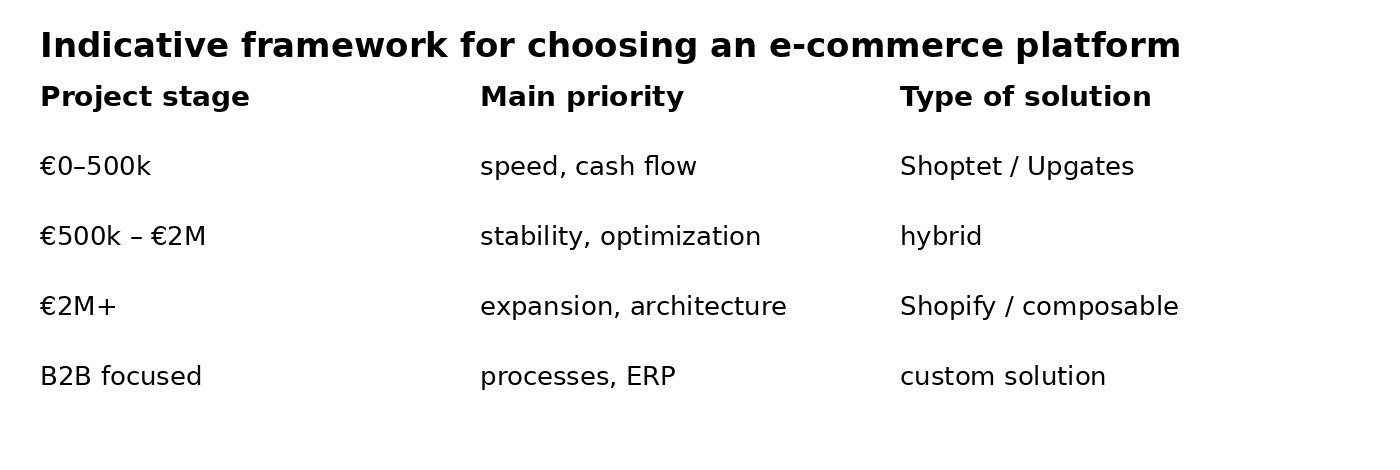
This framework is not a one-size-fits-all guide, but rather a guide to how to approach platform selection strategically. In practice, the specific processes, growth stage, and what should scale the business, not hold it back, always determine the outcome.
A decision that determines further growth
There is no universally best e-commerce platform. However, there is the right platform for the right stage of growth, the right architecture for specific processes, and the right strategy for the company’s ambitions.
It is this decision that makes the difference between a solution that works today and a solution that will work in a few years.
Let’s scale where others stop. 💙
Do you want your e-commerce platform choice to support the growth of your project? Contact us and we will help you make a decision that won’t hold you back.